Entry Prices: What You Actually Pay to Own
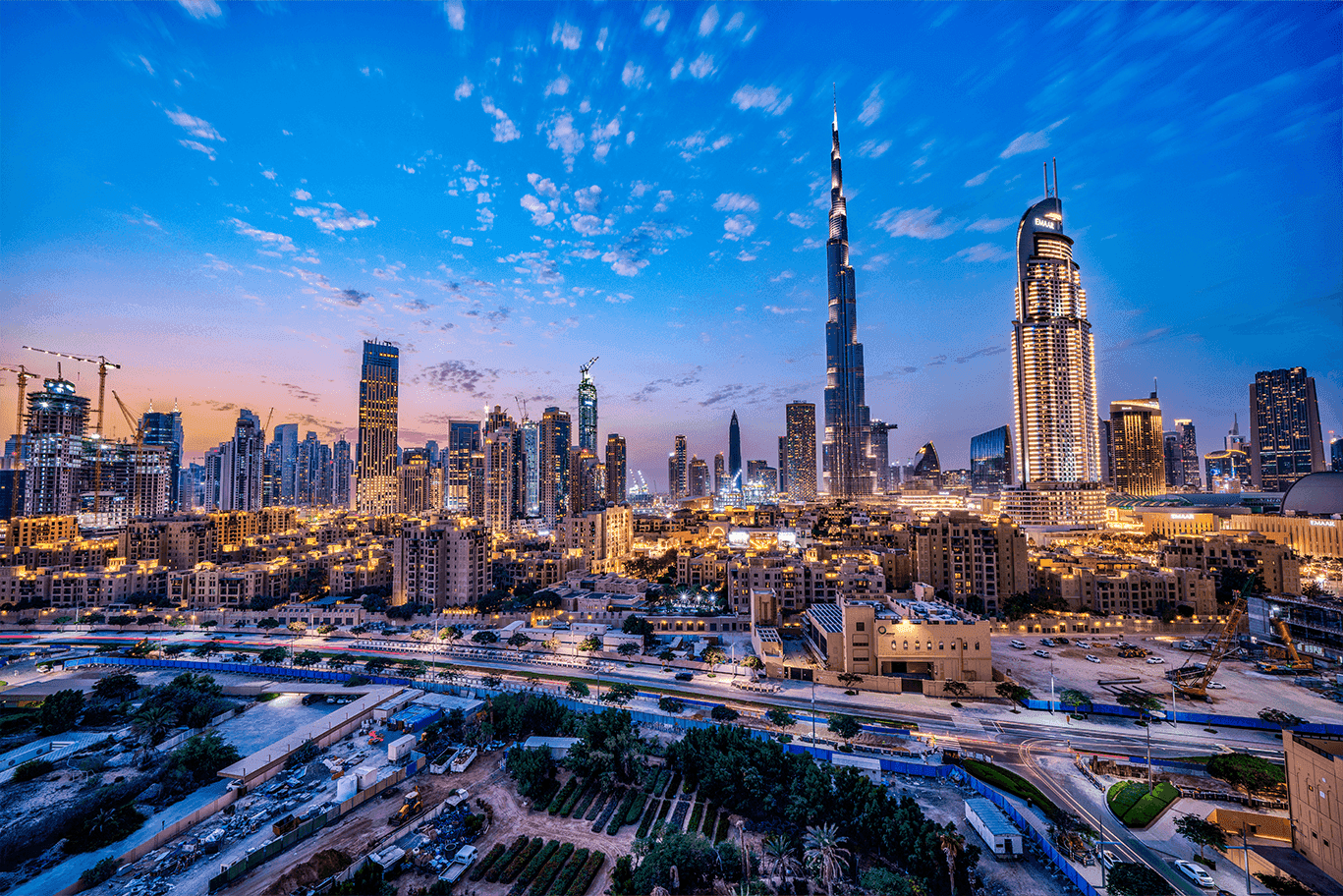
In Dubai, freehold property for foreign buyers is available across a long list of designated areas: Dubai Marina, Downtown Dubai, Business Bay, Jumeirah Village Circle, Arabian Ranches, Palm Jumeirah, and dozens more. At the lower end, a studio apartment in a well-managed building in Jumeirah Village Circle or Sports City runs AED 550,000 to AED 800,000. A one-bedroom in the same areas costs AED 800,000 to AED 1,400,000. To reach the UAE Golden Visa threshold, you need a property valued at AED 2,000,000 or more. That gets you a mid-tier one-bedroom in Dubai Marina or Business Bay, or a solid two-bedroom in a newer outer community.
Villa prices in established communities such as Arabian Ranches, The Springs, or Jumeirah Islands start from AED 3,500,000. Palm Jumeirah and Emirates Hills are in a different bracket, often AED 15,000,000 to AED 50,000,000 and above.
In Oman, foreign buyers can own freehold property only within the designated Integrated Tourism Complexes. The main ones around Muscat are Al Mouj Muscat (formerly The Wave), Muscat Hills Golf and Country Club, Jebel Sifah, and Saraya Bandar Jissah. In Salalah, Hawana Salalah allows freehold ownership. A one-bedroom apartment in a managed Muscat ITC starts at around OMR 55,000 to OMR 75,000, roughly AED 523,000 to AED 714,000. A two-bedroom apartment runs OMR 100,000 to OMR 160,000. Three-bedroom villas with private pools in top ITCs start around OMR 280,000 to OMR 380,000.
At mid-2026 USD equivalents, a one-bedroom in a Muscat ITC at OMR 65,000 is roughly USD 169,000. An AED 2,000,000 Dubai apartment is roughly USD 545,000. The gap in entry cost is real and meaningful for overseas buyers working within a defined budget.
Rental Yields: Which Market Pays Better Income
Rental yield is one of the clearest points of difference between the two markets.
In Dubai, gross yields on residential apartments in established areas like Dubai Marina, Business Bay, and JLT run 4 to 6 percent annually. In newer, less central areas with lower purchase prices such as Dubailand or International City, yields can reach 7 to 8 percent, but vacancy risk is higher and the tenant profile is different. Short-term rental via Airbnb and similar platforms is legal in Dubai with a DTCM permit, and well-managed furnished apartments in tourist-heavy areas can push effective yields to 8 to 10 percent gross, though management fees, licensing costs, and furnishing depreciation reduce the net figure.
In Oman's ITCs, the standard model includes a professional property management service operated by the developer or an approved operator. These services handle both long-term residents and short-term tourist lettings. Gross yields on managed ITC apartments in Muscat range from 6 to 9 percent annually. In Salalah's Hawana complex, which benefits from the khareef tourism peak from July to September, yields in top-occupancy units have reached 9 to 11 percent in strong years, though that is a seasonal business and occupancy varies considerably outside peak months.
The yield gap exists because Oman's purchase prices are lower relative to the rental income a comparable property generates. A OMR 65,000 apartment generating OMR 4,500 per year in net rent is a 6.9 percent yield. An AED 2,000,000 Dubai apartment generating AED 90,000 per year is 4.5 percent. The numbers reflect market maturity and liquidity premium. Dubai buyers are paying partly for ease of resale, not just for income.
Capital Growth: How Prices Have Moved and Where They Are Heading
Dubai's residential property prices between 2020 and 2024 saw growth that surprised most analysts. Prime and mid-market areas rose 30 to 55 percent in that period, driven by pandemic-era demand shifts, the Golden Visa programme attracting a new category of international buyers, strong off-plan absorption, and relatively constrained supply in well-located projects. This rate of appreciation is not a baseline to plan around going forward. By mid-2026 most analysts are projecting a moderation to 3 to 7 percent annual price growth for established residential areas, which is still respectable but a very different picture from recent years.
Oman's property market in the ITCs has seen steadier, more moderate capital appreciation. Typical annual growth in established ITC projects has been 3 to 5 percent per year over the past decade, with limited sharp cycles in either direction. The stability is partly a function of market size with fewer speculative buyers, partly the product model of managed resorts with institutional oversight, and partly Oman's broader economy, which has benefited from infrastructure investment and tourism development. The Oman Vision 2040 program continues to channel public investment into tourism infrastructure, which supports the long-term case for ITC valuations.
For international buyers focused on capital preservation, one important consideration is that both AED and OMR are pegged to the US dollar. Any capital gain is denominated in a hard currency that holds value over time. A property in Muscat that appreciates 4 percent annually in OMR terms is growing at roughly the USD rate, providing a stable store of value for buyers converting from weaker currencies.
Residency Thresholds: What Each Property Gets You
Residency is often what drives the final decision for overseas buyers, so it is worth being precise about the thresholds.
In the UAE, the owner of a completed property with a title deed qualifies for a 2-year UAE investor visa; since 1 May 2026 there is no minimum property value for a sole owner. A purchase of AED 2,000,000 or more qualifies for the 10-year UAE Golden Visa, and several properties can be summed. The Golden Visa covers the primary applicant plus spouse and dependent children. It provides UAE bank account access, an Emirates ID, access to the UAE health and education systems, and a widely recognised residency document. Holders must visit the UAE at least once during the validity period to keep the visa active. Off-plan property qualifies if the developer is approved, and a mortgaged property qualifies with a bank letter.
In Oman, the Golden Residency starts from OMR 200,000, approximately USD 520,000 or AED 1.9 million, close to the UAE Golden Visa threshold. Oman's two-year property-owner visa lists no minimum value. This catches many buyers off guard. Oman also offers the Golden Residency through company, bond, share and deposit routes at the same OMR 200,000 level. Oman's Golden Residency is a 10-year renewable residency. It grants the holder access to local banking, the right to sponsor family members, and Omani health services as a resident. It is a practical, comfortable residency but does not carry the same international recognition or utility as the UAE Golden Visa.
For a buyer whose primary objective is residency on a modest property budget, the UAE offers a clearer path. At AED 2,000,000 you can secure a Golden Visa. In Oman you would need to invest roughly 2.4 times that amount in property alone to qualify. Many foreign buyers purchase property in Oman purely for yield and portfolio diversification, without targeting the residency visa.
Transaction Costs and Ongoing Ownership Costs
Transaction costs in Dubai are among the highest in the region. The Dubai Land Department transfer fee is 4 percent of the property value, paid by the buyer. On a AED 2,000,000 purchase, that is AED 80,000 in transfer fees alone. Agency fees are typically 2 percent of the purchase price for secondary market transactions. Legal fees for title review and purchase agreement preparation run AED 3,000 to AED 8,000 depending on complexity. In total, expect to budget 5 to 7 percent of the purchase price as transaction cost on top of the property price.
Ongoing costs in Dubai include service charges per square foot per year by the building's owners association, which typically run AED 10 to AED 25 per square foot annually. A 900 square foot apartment with AED 15 per square foot service charge costs AED 13,500 per year in maintenance fees before utilities. There is no property tax in Dubai.
In Oman, the registration fee for freehold ITC properties is typically 3 percent of the registered value, paid to the Ministry of Housing and Urban Planning. Agency fees run 2 percent. Legal fees are lower than Dubai, typically OMR 500 to OMR 1,500. Total transaction cost comes to around 5 to 6 percent of the purchase price. Annual service charges in Omani ITC complexes typically run OMR 1,000 to OMR 2,500 per apartment per year depending on the complex and the services included in the management package. For properties enrolled in the managed rental pool, a management fee of 15 to 25 percent of rental income is deducted before the owner receives their share.
Oman charges no property tax and no capital gains tax on ITC property sales. Dubai also has no capital gains tax. Both markets are clean from a buy-hold-sell perspective.
Liquidity: How Quickly Can You Sell If You Need To
Liquidity is where the two markets are genuinely not comparable, and this matters more than most first-time investors realise.
Dubai is one of the most liquid residential property markets in the world. The Dubai Land Department records transaction volumes in the tens of thousands of deals per month. There are more than 6,000 registered real estate brokers in the emirate, transparent online price data through Property Finder and Bayut, and a buyer pool that includes UAE residents, international investors, off-plan speculators, and end users from over 100 nationalities. A well-priced property in a popular Dubai area can generate serious buyer interest within days and close in 30 to 60 days. This liquidity is a real asset, particularly for buyers who might need to access capital on a shorter timeline.
Oman's secondary real estate market, specifically for ITC properties, is materially smaller. There are active agents and a functioning resale market within individual projects, but the total buyer pool across all Muscat ITCs is a fraction of Dubai's. Resale timelines of 6 to 18 months are common for ITC properties. This is not because the properties are poor quality or overpriced. It simply reflects a smaller, younger market. In Salalah, the secondary market is even thinner given the geographic concentration of buyers and the seasonal nature of the tourism economy.
This has a direct implication for buyers planning their investment horizon: if there is any chance you will need to liquidate the asset within 2 to 3 years, Dubai is the more appropriate market. Oman is the right choice for buyers with a 5 to 10 year or longer horizon who are not dependent on a quick exit.
Lifestyle Comparison: Where You Would Actually Live
Dubai is a global city in every sense. It has hundreds of international schools across multiple curricula, world-class private hospitals, a retail and dining scene that covers every nationality and price point, and reliable connectivity to virtually every major airport in the world. Expat life in Dubai is comfortable, service-oriented, and fast-paced. The cost of living is high: a family of four in a reasonable area spends AED 25,000 to AED 40,000 per month on rent, school fees, transport, and everyday expenses. Summers are genuinely extreme at 45 degrees Celsius or above, and most residents with children leave for two months. The social environment is cosmopolitan but transient.
Muscat is a different kind of city. It is a well-maintained, clean, safe capital with a population under 1.5 million in the greater metropolitan area. Traffic is lighter than Dubai. The coastline is spectacular. The pace is slower and the culture more conservative. International schools exist but the selection is narrower. Private hospital quality has improved significantly over the past decade, but for complex medical needs, Dubai or India remain the preferred destinations for most Oman residents. The cost of living in Muscat is roughly 25 to 40 percent below Dubai across housing, food, and services.
For buyers primarily using the property as an investment and living elsewhere, both cities work equally well from a remote management standpoint. Oman's managed ITC rental programmes mean owners can earn income without being resident. The decision in that case becomes purely about numbers and investment horizon.
Which Buyer Fits Which Market
Based on the buyers Alsama has worked with across both markets, here is a direct recommendation framework.
Dubai is the right market if: your budget reaches AED 2,000,000 and residency is a core objective; you want the strongest possible exit liquidity and may need to sell within 3 to 5 years; your priority is capital growth over income yield; you or your family intend to live in the property and value international school and hospital access; or you want a property that opens doors in international banking and travel.
Oman is the right market if: your budget is below AED 2,000,000 and you want more property for your capital; income yield is more important to you than maximum liquidity; you have a long investment horizon of 7 years or more; you are considering relocating your family to a calmer, lower-cost environment; or you want exposure to a market that has not already run 50 percent in four years.
Some buyers do both, and it is a structure that makes sense if the budget allows. A Golden Visa-qualifying property in Dubai for residency and liquidity, paired with a smaller income-generating ITC apartment in Muscat for yield and portfolio diversification. Alsama has set up exactly this combination for a number of international clients.
Both AED and OMR are dollar-pegged currencies. Buying property in either market converts capital into a hard-currency asset. For buyers converting from weaker currencies, this currency preservation dimension is as important as the yield or capital growth calculation. Alsama's multilingual team can walk you through exactly how this works for your specific budget and situation in a free first consultation.